
1. Intellectual Property Rights
1.1. Disclaimer
This is a document made available by DASH-IF. The technology embodied in this document may involve the use of intellectual property rights, including patents and patent applications owned or controlled by any of the authors or developers of this document. No patent license, either implied or express, is granted to you by this document. DASH-IF has made no search or investigation for such rights, and DASH-IF disclaims any duty to do so. The rights and obligations which apply to DASH-IF documents, as such rights and obligations are set forth and defined in the DASH-IF Bylaws and IPR Policy, including but not limited to patent and other intellectual property license rights and obligations. A copy of the DASH-IF Bylaws and IPR Policy can be obtained at https://dashif.org/.
The material contained herein is provided on an "AS IS" basis and, to the maximum extent permitted by applicable law, this material is provided AS IS, and the authors and developers of this material and DASH-IF hereby disclaim all other warranties and conditions, either express, implied, or statutory, including but not limited to any (if any) implied warranties, duties, or conditions of merchantability, of fitness for a particular purpose, of accuracy or completeness of responses, of workmanlike effort, and of lack of negligence.
In addition, this document may include references to documents and/or technologies controlled by third parties. Those third-party documents and technologies may be subject to third-party rules and licensing terms. No intellectual property license, either implied or express, to any third-party material is granted to you by this document or DASH-IF. DASH-IF makes no warranty whatsoever for such third-party material.
Note: IPR declarations relevant to DASH-IF specifications are published at https://dashif.org/ipr-declarations/.
1.2. Modal Verbs Terminology
In the present document, shall, shall not, should, should not, may, need not, will, will not, can, and cannot are to be interpreted as described in the ETSI Drafting Rules (Verbal forms for the expression of provisions). must and must not are NOT allowed in DASH-IF deliverables except when used in direct citation.
2. Scope
This document specifies DASH-IF IOP v5 requirements and recommendations for on-demand services. An on-demand service is a DASH Media Presentation for which the media is available before playback and for which clients have flexibility to start, pause, seek, and perform trick-mode operations subject to the advertised MPD and media structure.
This part builds on Part 2. Media-specific constraints are defined in Parts 7, 8, and 9. Content protection constraints are defined in Part 6.
3. References
The following referenced documents are necessary for the application of this part:
-
ISO/IEC 23009-1 [MPEGDASH].
-
ISO/IEC 14496-12 [ISOBMFF].
-
ISO/IEC 23000-19 [MPEGCMAF].
-
DASH-IF IOP v5 Part 2, Core Principles and CMAF Mapping.
Note: ETSI TS 103 285 [DVBDASH] (the "DVB-DASH" profile) defines an On-Demand profile that constrains a subset of the on-demand mechanisms described in this part. Alignment notes are provided in the relevant clauses below.
4. Terms and Definitions
- On-Demand Service
-
A DASH service offered using a static Media Presentation where the announced media is available independently of wall-clock publication over time.
- DASH-IF On-Demand Profile
-
The DASH-IF on-demand interoperability profile historically identified by
http://dashif.org/guidelines/dash-if-ondemand. - Mixed On-Demand Content
-
Multi-Period on-demand content in which different Periods may use different on-demand-compatible representation structures, subject to explicit profile signalling.
5. On-Demand Services
5.1. Introduction
MPEG-DASH provides several tools for on-demand streaming. A DASH Media
Presentation with MPD@type="static" indicates that all media announced in the
MPD is available for playback. This enables clients to start at different times,
pause playback, seek, and perform trick modes such as fast-forward where
supported by the media and MPD.
Earlier IOP versions described both on-demand services using live-profile segment structures and on-demand services using the MPEG-DASH On-Demand profile. IOP v5 keeps the distinction as an authoring choice, but Part 2 provides the common timing and Segment information model.
5.2. Common MPD Requirements
For an on-demand service:
-
MPD@typeshall bestatic. -
The Media Presentation duration shall be determinable from
MPD@mediaPresentationDurationor from the duration of the last Period. -
MPD@minimumUpdatePeriodshall not be present. -
MPD@timeShiftBufferDepthshould not be present; if present, a client is expected to ignore it. -
MPD@suggestedPresentationDelayshould not be present; if present, a client is expected to ignore it. -
Segment availability shall not depend on wall-clock publication over time.
5.3. Period Timing
For an on-demand service (static presentation):
-
The first Period shall start at the zero point of the MPD timeline (with a
Period@startvalue of 0 seconds). -
The last Period shall have a
Period@duration.
These constraints ensure that the Media Presentation has a well-defined start and end point, enabling clients to accurately determine the total presentation duration and support seeking operations throughout the entire presentation.
In a static presentation, every Representation shall provide enough Media Segments to cover the entire time span of its Period (see Part 2, Section "Necessary Segment References in Static Presentations").
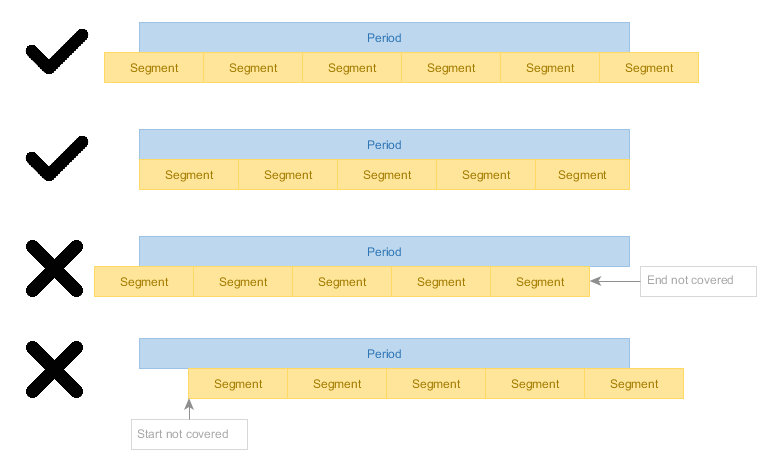
See Part 2 for general period timing rules that apply to all DASH-IF Media Presentations. See the DASH-IF Guidelines-TimingModel document [DASHIF-TIMING] for detailed discussion of the DASH timing model.
5.4. Segment Information Derivation
Based on the MPD, a DASH client derives the list of Segments for each Representation in each Period. For each Period, the Period start and Period end are computed using the rules of ISO/IEC 23009-1 and Part 2. For each Representation, the Segment list is computed from SegmentTemplate, SegmentTimeline, SegmentBase, or the selected on-demand profile structure.
For SegmentTimeline-based Representations, the S elements and their @t,
@d, and @r values define the media timeline, including any gaps. Each Media
Segment has an earliest presentation time and an accurate Segment duration,
which may be estimated from the MPD or determined from the Segment itself.
Synchronized playout and seamless switching are achieved by aligning Representations according to presentation time within the Period. Clients shall use presentation time, not download order, as the synchronization basis across Adaptation Sets and within switchable Representations.
5.5. On-Demand Services Using Live-Profile Segment Structures
On-demand content may use Segment structures also used by live services, for
example SegmentTemplate with $Number$ or $Time$. This can simplify reuse of
live packagers and client logic. When such structures are used for an on-demand
service, the MPD remains static and the dynamic-service attributes listed in
§ 5.2 Common MPD Requirements shall not be used.
Reconstruct the v4.3 table "Information related to Segment Information for Using Live Profiles for On-Demand Services" and align it with the Part 2 SegmentTemplate parameter table. [GROUNDED_BY=dashif-iop-v4-3#74..#80]
5.6. On-Demand Services Using the MPEG-DASH On-Demand Profile
On-demand services may use on-demand DASH profiles defined by ISO/IEC 23009-1.
Historically, DASH-IF defined the DASH-IF On-Demand Profile identified by
http://dashif.org/guidelines/dash-if-ondemand.
The DASH-IF On-Demand Profile is based on the MPEG-DASH Extended ISO BMFF On-Demand profile. The following requirements apply unless superseded by an IOP v5 profile decision:
-
Each Representation shall contain one Segment that complies with the Indexed Self-Initializing Media Segment structure.
-
@indexRangeshall be present in the MPD. -
Only a single
sidxbox shall be present for the Representation index. -
The
sidxbox shall describe the subsegments (movie fragments) needed for client request construction.
Note: v4.3 emphasized operational advantages of the on-demand profile: fewer files, easier content management, improved cache behaviour, and lower packager/origin/CDN complexity.
Note: The DVB-DASH [DVBDASH] On-Demand profile is aligned with this structure:
it requires exactly one Segment per Representation using Indexed addressing
(SegmentBase with @indexRange), a single sidx box describing all subsegments,
and disallows Period.SegmentList. DVB-DASH additionally requires
Representation@mimeType, codec parameters conformant to the applicable
DVB-DASH media clause, and a single BaseURL per Representation pointing to the
indexed media file. Content authored per this section’s On-Demand profile
requirements is expected to remain compatible with DVB-DASH On-Demand players.
Confirm whether http://dashif.org/guidelines/dash-if-ondemand remains
the IOP v5 profile identifier, is deprecated, or is replaced by a new v5 URI.
[GROUNDED_BY=dashif-iop-v4-3#82..#84]
5.7. Service Offering Requirements and Guidelines
An on-demand service offering shall provide all MPD information required by the
selected Segment information mode or profile. If the On-Demand profile is used,
@indexRange shall allow the client to retrieve the Segment Index. The Segment
Index should be sufficient to build the subsegment request timeline for the
Representation.
For multi-Period on-demand content, Period timing shall be explicit and consistent. Adjacent Periods that are intended for continuous playout should follow the Good Multi-Period CMAF Content requirements of Part 2.
5.8. Client Operation, Requirements and Guidelines
A client supporting on-demand services shall parse the MPD, determine the Period and Representation timing, derive the Segment or byte-range request list, and schedule playback according to presentation time.
For the On-Demand profile, the client typically requests the initialization data
and the Segment Index, parses the sidx box, and constructs a list of URL and
byte-range requests for the referenced subsegments. A client may retrieve only
the initial portion of a Representation index to reduce startup delay, provided
it can continue retrieving index information as needed without violating the
presentation timeline.
5.9. Mixed On-Demand Content
On-demand content may be offered as multiple Periods. Earlier IOP versions
identified a DASH-IF Mixed Profile http://dashif.org/guidelines/dash-if-mixed-ondemand.
A mixed on-demand service may contain multiple Periods, and each Period shall
explicitly signal the applicable profile or representation structure.
A client claiming support for mixed on-demand content shall support multi-Period playback and the representation structures used by the Periods. Mixed on-demand content does not imply support for dynamic services.
Confirm the status of the DASH-IF Mixed On-Demand profile URI in IOP v5 and define the relationship to Part 2 Good Multi-Period CMAF Content. [GROUNDED_BY=dashif-iop-v4-3#90]
Note: DVB-DASH [DVBDASH] does not define a mixed on-demand profile; a DVB-DASH On-Demand player is only required to support single-profile, single-Period (or uniformly-structured multi-Period) on-demand content as specified by the DVB-DASH On-Demand profile. Services relying on Mixed On-Demand Content should not assume DVB-DASH player compatibility unless every Period independently conforms to the DVB-DASH On-Demand profile.
6. Open Issues and Work Items
| Topic | Status | Source grounding | Next action |
|---|---|---|---|
| Live-profile segment structures for on-demand | Partial | dashif-iop-v4-3#74..#80
| Rebuild the MPD/Segment information table and align with Part 2. |
| DASH-IF On-Demand profile URI | Open | dashif-iop-v4-3#82..#84
| Confirm keep/deprecate/replace for IOP v5. |
sidx constraints
| Partial | dashif-iop-v4-3#87..#89
| Review against current ISO BMFF and MPEG-DASH editions. |
| Mixed on-demand profile | Open | dashif-iop-v4-3#90
| Confirm URI/status and align with Part 2 multi-Period CMAF. |
| Trick modes | Open | v4.3 related clauses | Decide whether on-demand trick-mode requirements live in Part 3 or Part 11. |
7. Change History
| Version | Date | Change |
|---|---|---|
| 0.1 | Initial | Initial Bikeshed draft from DASH-IF IOP v4.3 on-demand services, aligned with Part 2. |
| 0.2 | Reconciliation | Added static period coverage diagram and cross-reference to Part 2 necessary segment references; created images directory. |